It is the fastest shipping route between Europe and Asia and one of the Egyptian government's principle sources of hard currency.
President Abdel Fattah el Sisi announced a $4bn project this week to boost the Suez canal's shipping capacity, cut transit times and help Egypt's ailing economy.
Sisi has also said that the military will oversee the Suez project - in concert with an expanding military role in Egypt's economy.
Much of the Egyptian's military's financial dealings are unknown. Its budget is secret and its industries are unaudited and untaxed. More
President Abdel Fattah El Sisi denied on Sunday 24/8/2014 that the Egyptian Armed Forces had carried out any military operation inside the Libyan lands.
At a meeting with editors-in-chief of Egyptian newspapers and the Middle East News Agency, Sisi refuted reports circulated by the Doha-based Aljazeera channel in this regard, saying "We did not carry out any military operation outside our borders till now".
"Our forces are stationed inside our territories," he added.
The President stressed that Egypt is concerned about the security of the Libyan lands and is holding necessary consultations with Algeria, Tunisia and other neighboring countries to find a political solution that would bring about stability in Libya. (SIS)
Two unidentified airstrikes targeting Islamist militia positions in Libya's capital killed 15 fighters and wounded 30 on Saturday. A senior militia leader accused Egypt and the United Arab Emirates of being behind the attacks on their posts.
The mysterious airstrikes Saturday were the second this week to target Islamist militia posts in the capital. They have fueled speculation that foreign powers are covertly intervening in Libya's militia violence because Libya's air force does not possess the guided ordinance apparently used in the strikes and the country's army is reeling from weeks of intense fighting driven by polarized politics.
AOI was established in 1975 with the aim of building an advanced technological industrial base. Egypt, Qatar, Saudi Arabia, and the United Arab Emirates founded the Arab Organization for Industrialization (AOI) and capitalized the new organization with more than US$1 billion.
These countries set up the AOI to establish an Arab defense industry by combining Egypt's managerial ability and industrial labor force with the Arab countries' oil money and foreign technology. The bulk of the arms manufacturing was intended to take place in Egypt. But the AOI floundered before it could become a major arms producer, because the Arab states broke relations with Egypt over Sadat's peace initiatives with Israel. Egypt kept the AOI functioning in spite of a 1979 proclamation by Saudi Arabia dissolving the body. Some of the AOI's members have renewed military contacts, but as of 1989, the AOI has not been restored to its original status.
The AOI has operated as an independent enterprise since 1979 and is exempt from Egyptian taxes and business restrictions. The AOI consists of nine companies, five wholly owned by Egypt and four joint ventures. The Egyptian plants manufactures missiles, rockets, aircraft engine parts, armored personnel carriers, electronics, radar, communications gear, and assembled aircraft. A joint venture with French firms assembles Gazelle combat helicopters and helicopter engines. A joint venture with the British manufactures the Swingfire antitank guided missile, while another venture with the Chrysler Corporation produces jeeps.
The U.S. government has awarded an initial $213 million to Lockheed Martin [NYSE: LMT] for long-lead tasks for the production of 20 new Advanced Block 52 F-16 aircraft for Egypt.
"This is a great day for Lockheed Martin and a testament to the enduring partnership and commitment we have made to the government of Egypt. We remain committed to providing our customer with a proven, advanced 4th Generation multirole fighter," said John Larson, vice president, Lockheed Martin F-16 programs. "This marks the 53rd follow-on buy of F-16s by 14 repeat customers. The aircraft we will deliver to Egypt will join the fleet of more than 4,400 F-16s representing 25 nations."
The new aircraft order includes 16 F-16Cs and 4 F-16Ds, and will supplement the Egyptian Air Force's (EAF) existing fleet of F-16s and contribute to the modernization of the EAF. The final Egyptian F-16 under this contract will be delivered in 2013.
Egypt was the first Arab country to purchase F-16s through a Foreign Military Sales program called Peace Vector. The Egyptian Air Force received a total of 42 F-16s in its first order in 1980 and since then has purchased five more lots of aircraft, for a total of 240 F-16 Fighting Falcons.
Headquartered in Bethesda, Md., Lockheed Martin is a global security company that employs about 140,000 people worldwide and is principally engaged in the research, design, development, manufacture, integration and sustainment of advanced technology systems, products and services. The Corporation reported 2009 sales of $45.2 billion.
Egypt quickly announced that, by July 1964, it would launch a satellite designated the al-Najm (Star) into a low earth orbit utilizing the al-Ra'id, or a three-stage derivative, as a launch vehicle. The al-Najm was reported to be designed to explore the earth's electromagnetic field.
During April 1963 Egypt reportedly test-fired two of its new missiles (presumably the al-Zafir). These tests are believed to have used the transporter-erector-launchers (TEL) designed specifically for them. The implications of these tests (e.g., mobile missiles could be moved closer to the Israeli border and were more difficult to locate and destroy), raised the threat to Israel.
Three months later, during the military parade celebrating the 11th anniversary of the revolution, Egypt presented another surprise when it displayed four two-stage al-Ra'id (Pioneer) missiles. Egyptian officials described the al-Ra'id as a "space research rocket," but most observers properly identified it as a surface-to-surface missile. Published sources estimate that the al-Ra'id could carry either a 1,800 kg high explosives warhead or lift 900 kg into a relatively low earth orbit of approximately 482 km. The range of the al-Ra'id in the surface-to-surface role was estimated to be approximately 1,000 km. It was also reported at the time of the parade that the al-Ra'id has been successfully launched several times during May and June. Like the al-Zafir and al-Kahir, the al-Ra'id was liquid fueled, probably also utilizing kerosene and nitric acid. Egypt quickly announced that, by July 1964, it would launch a satellite designated the al-Najm (Star) into a low earth orbit utilizing the al-Ra'id, or a three-stage derivative, as a launch vehicle. The al-Najm was reported to be designed to explore the earth's electromagnetic field.
Beginning in the 1950s, Egypt determinedly pursued an indigenous missile production capability.
Yet difficulties in obtaining parts, loss of suppliers, and the departure of key scientists from the country interrupted development of Egypt's missile program. By the time of the 1967 Six-Day War, the program had come to a virtual standstill. Lacking indigenous production capabilities, Egypt turned to the Soviet Union for help. Moscow provided a small number of Scud B short-range ballistic missiles, subsequently used to minimal military effect by Egypt during the October 1973 Arab-Israeli War.
Egyptian leaders continued to believe that ballistic missiles would play a significant role in any future regional conflict, and therefore remained committed to developing strong indigenous capabilities.
From the 1970s to the 1990s, Egypt initiated missile technology partnerships with the USSR, North Korea, Argentina, and Iraq. The projects yielded mixed results, and although Egypt was able to make some key improvements to its arsenal, pressure from members of the Missile Technology Control Regime (MTCR) succeeded in largely ending Egyptian ballistic missile development efforts in the 1990s. Since abandoning its ballistic missile ambitions, Cairo has focused on improving its air and sea defense systems, primarily through U.S. military technology transfers, and has cooperated with Russia to improve its satellite capabilities.


 AOI was established in 1975 with the aim of building an advanced technological industrial base.
  The U.S. government has awarded an initial $213 million to Lockheed Martin [NYSE: LMT] for long-lead tasks for the production of 20 new Advanced Block 52 F-16 aircraft for Egypt.
 Egypt quickly announced that, by July 1964, it would launch a satellite designated the al-Najm (Star) into a low earth orbit utilizing the al-Ra'id, or a three-stage derivative, as a launch vehicle. The al-Najm was reported to be designed to explore the earth's electromagnetic field.


 Nile-23 vehicle... Almost the same as Sinai-23 AA vehicle, except that it uses stinger missiles instead


 Sinai-23 AA vehicle, it consists of a radar-guided twin-parrel AA gun with Ain Skr AA missiles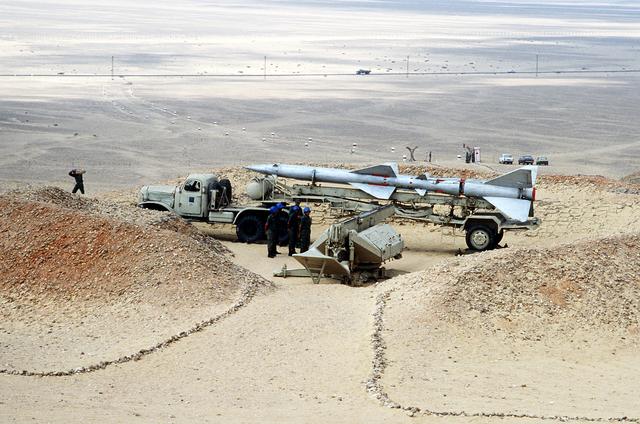
 During April 1963 Egypt reportedly test-fired two of its new missiles (presumably the al-Zafir). These tests are believed to have used the transporter-erector-launchers (TEL) designed specifically for them. The implications of these tests (e.g., mobile missiles could be moved closer to the Israeli border and were more difficult to locate and destroy), raised the threat to Israel.
 Beginning in the 1950s, Egypt determinedly pursued an indigenous missile production capability.